
The Real Driver Is Production Capability
Most shops don’t come to us saying, “I want a robot.” They come because they need to produce more, and they cannot just hire their way out of the problem. Even if you already have a strong welding team, scaling output two, three, four times is not realistic by adding headcount. You hit a wall.
Robotic welding gives you a more repeatable process and a more predictable schedule, which is what owners and production managers want.
The Biggest Misconception: “We’re High Mix, So Robots Won’t Work Here”
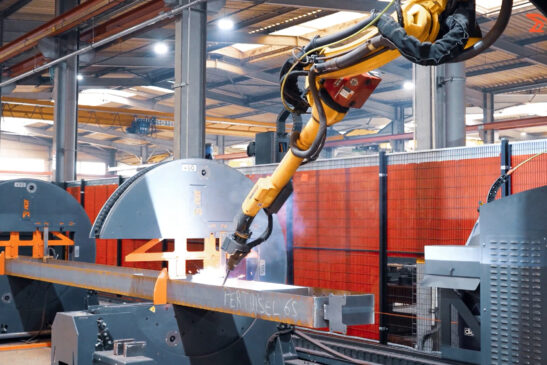
This is the number one myth. Many job shops assume automation only works if you weld the exact same part every day. But that’s not the case. Robotic welding has become accessible even for high-mix, including one-off work, because modern CAD-driven workflows can generate consistent robot programs without manual teach pendant programming.
A lot of shops do structural steel and heavy fabrication work like cross frames, skids, trailers, and trusses. Even if every job is different, automatic programming now allows welding paths to be created in just a few seconds, instead of the hours it once took using a teach-pendant approach. That’s why the real question is no longer “Does robotic welding work for me?” but rather “What kind of automation do I need for my type of production?”

Upstream Matters More Than People Realize
If you take one thing from this, let it be this: you can’t automate your way out of inconsistent inputs. I use a simple analogy with customers. It’s like baking a cake. If the ingredients are rotten, the cake won’t be good. A robot will not fix bad fit-up, uneven cuts, or inconsistent prep. It will just make a bad product faster.
When I’m assessing fit, I look at what’s happening before welding. Do they have consistent cutting and prep? Do they have automation upstream already? Are they still doing everything manually?
Repeatability Is A Cost Lever, Not Just A Speed Lever
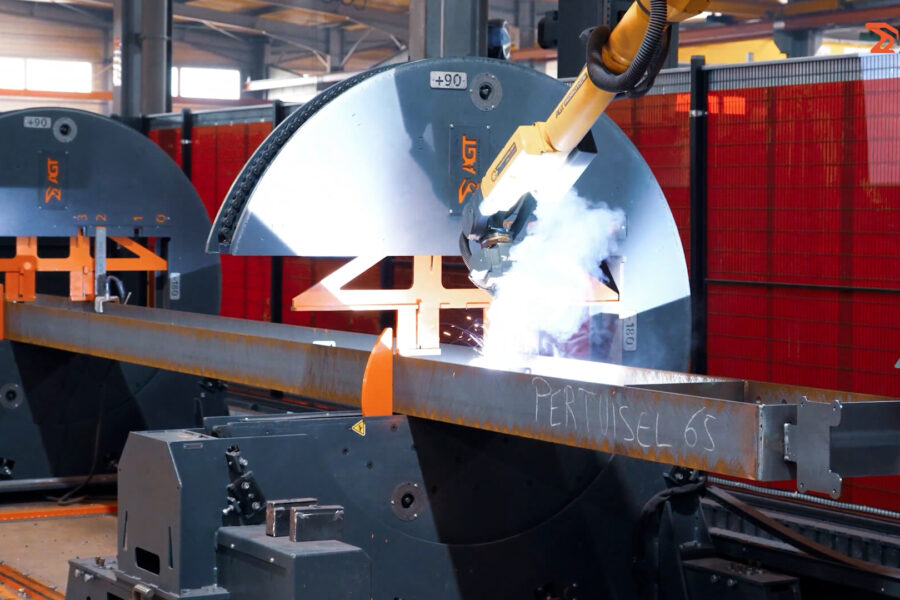
People focus on arc time and parts per hour. That matters, but repeatability hits something most shops underestimate: weld variation.
Most welders oversize welds a bit because undersized welds fail inspection. The problem is that small increases in weld size can drive a big jump in weld volume, which means more wire, more gas, more time, and more labor cost per foot of weld. When you control the process, you control those variables.
Quality and rework also show up here. Rework is expensive, and it is also disruptive. It pulls people off planned work, delays shipping, and creates a schedule you can’t trust.
Predictability Changes How You Run The Business
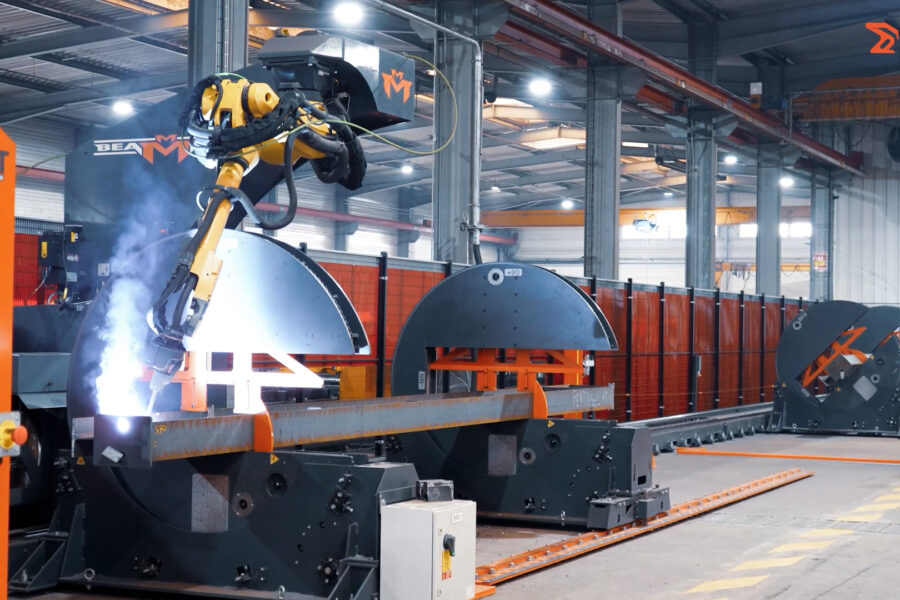
One of the words I come back to is predictability. With robotic welding, you get better visibility into how long a beam, a column, or a fabricated assembly should take. Manual welding has a lot of variances. People work at different speeds, can call in sick, or schedules move around.
When you have real numbers, you bid more confidently, you plan labor better, and you can make smarter purchasing decisions.

Programming Is Too Hard
A lot of people still imagine old-school manual or teach pendant programming. Modern systems are not designed for that kind of barrier. The goal is to make operation realistic for normal shop personnel without them needing skilled programmers.
In practical terms, software can do a lot of heavy lifting now. With AGT’s Cortex auto-programming, for example, the robot path and weld sequence are generated from the CAD model, so the workflow shifts away from hand-coding motions and toward reviewing, confirming, and running a repeatable process.
Training is often more like learning where to click and how to run the workflow. If someone can navigate basic screens, they can learn it.

The Practical Barriers I Hear Most Often
Here are the two that come up constantly:
- Floor space. Shops are packed. Nobody wants to stop production to install a system.
- Perceived complexity. People see a robot and assume it’s difficult until they see it running in a real shop.
The way through that is planning and proof. Many shops keep shipping products during installation, and you can plan the footprint ahead of time. The bigger question is usually: what’s the cost of not doing it?
The First Step Is Removing Uncertainty
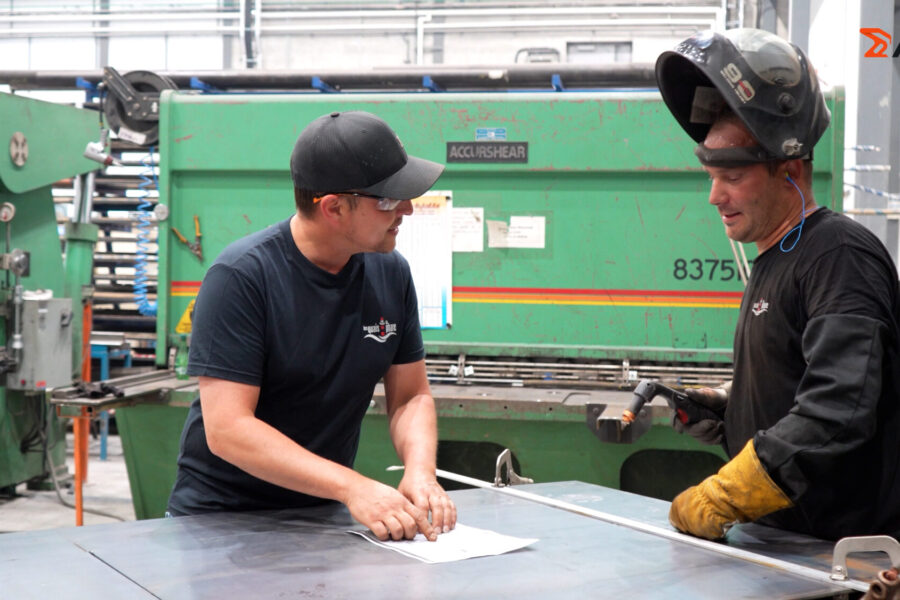
For a hesitant owner or production manager, I don’t think the first step is buying anything. The first step is getting clarity.
We can take one of your drawings, model it in a 3D virtual environment, and show you what the cycle time looks like and what the robot can weld. Then we ask the simple question: how long does it take you today? A lot of shops do not actually know, and that uncertainty is what they’re living with every day.
When you replace guesswork with numbers, the decision becomes much easier.

Final Thought
Robotic welding isn’t just for the big guys anymore because it’s more accessible, more flexible for real-world job shops, and it takes a process that people treat like an art and makes it more scientific and repeatable.
If you’re unsure whether it makes sense for your shop size, start small. Share one typical part or drawing, and an AGT expert can help you estimate cycle time, identify a realistic first application, and highlight any upstream improvements that will make automation successful.
FAQ
Yes, and in many cases the bigger question is the cost of not doing it. If you are struggling to hire, dealing with schedule variability, or trying to grow output, staying fully manual can quietly become the more expensive option over time. Competition is getting tougher, and more fabricators are adopting automation because it helps them produce more predictably with fewer staffing constraints. With robotic welding systems more accessible today than they were even a few years ago, it is a good time to start evaluating what it could look like in your shop.
Not at all. High mix shops can succeed even if the overall volume is low. With CAD-driven workflows and tools like AGT’s Cortex auto-programming, robot programs can be generated directly from the CAD model, which makes it practical to run even one-off parts without spending hours doing manual teach pendant programming.
No. With CAD-to-weld software like AGT’s Cortex auto-programming, the robot programs are generated from the CAD model instead of being built manually with a teach pendant. In most cases, training focuses on the workflow and operating the interface, so the skill requirement is closer to learning the system screens than learning robotics programming.
Space is a common constraint, but it is usually manageable with planning. As a rule of thumb, lighter robotic welding setups can take roughly the footprint of about two welding bays, depending on the configuration and material flow. The important part is evaluating it early in the process so the system can be sized and laid out to fit your shop floor and production workflow, rather than forcing you into a one-size-fits-all cell.
Start with basics: cost per foot of weld (or best estimate), rework rate, and a typical part mix. Many shops realize they are not measuring what matters until they are asked.
With AGT Robotics, you are not just buying a welding robot. You are partnering with a team that supports you through the full life of the system, from evaluation and setup to training, service, and long-term performance. AGT’s organization includes software and robotics expertise, welding engineering, mechanical engineering, and a dedicated after-sales support team, so smaller and mid-size shops can lean on experienced specialists instead of needing all that in-house.
Latest AGT News
Stay informed with our in-depth articles on the latest innovations and developments in the world of robotics and automation.